Category: Local News Sustainability
Ill gets L3Cs and Chicago Community Trust/Knight $ offered for news orgs of all types!
 What a week – Gov. Quinn signs L3Cs into law AND the Chicago Community Trust with the Knight Foundation Community Information Challenge offers funding for Community News that Matters to NPOs, to for-profits [we hope like the L3C], as well as to individuals – an incredible offering to the future of Chicago’s news stream!
Oh please, let’s see some collaboration here.The deadline is tight and fast approaching: Sept. 15.
Community News Matters
The Chicago Community Trust has created an innovative new program, Community News Matters, to spur the growth of new sources of local news and information about the Chicago region, in conjunction with the Knight Community Information Challenge. Through September 15, the Trust is soliciting proposals from nonprofits, for-profit businesses and individuals for new activities and projects that:
• Increase the flow of truthful, accurate and insightful local news and information in the Chicago region in new ways that engage residents, bring important issues to light, help people make sense of things and enable them to work together to find solutions;
• Help the Chicago region’s cutting-edge media innovators develop new forms, methods and models for providing this information that can be sustainable in the future.
There’s also a special information meeting:
Friday, August 21, 2009
10:00 a.m. to 12:00 p.m.
26th Floor Conference Room
111 East Wacker Drive
Chicago, IL 60601
The New News: Journalism We Want and Need, was the first part of the Community Trust’s initiative. The CCT went on to say:
Based on the findings of this report and recommendations received from the project’s advisory committee members, the Trust is issuing this Community News Matters Request for Proposals (RFP). The purpose of the RFP is to support and stimulate development of new ways to provide the Chicago region with the local news and information residents need to be good citizens and to improve both their quality of life and the vitality of their communities.
In November, the Trust will award grants and contracts to nonprofit organizations, individuals and for-profit companies for
activities and projects.The CCT says awards may be as large as $100,000, most will be in the range of $25,000 to $50,000. But the CCT does not say how many grants it will be making or how large the fund is.
Chicago news hounds have put enough skin in the game
Originally published in Huffington -Post
Show us the money.
“Us” being the new newsrooms.
The whole world has weighed in on solutions: Combine online with newsprint, news blogs with legacy investigative reporters, news aggregation with editorial curation, then crowd-fund, throw in some Google analytics, and subscription and accessibility fan clubs.
I’m not making this stuff up. To make your head spin do a Google or Twitter search on future of news or follow my Twitter stream @saduros.
Newspapers are meeting “secretly” and Google, Yahoo and other Web whizzes are conjuring new delivery systems.
I’ve talked at length with Tom Stites, who has worked at the Sun-Times, the Tribune and the New York Times. He has some great ideas for the future of journalism as a co-op that he’s laid out at the Banyan Project.
But as he says:
“The revenue model for making money from online journalism is a Rubik’s Cube that somebody’s got to crack the code on.”
It’s going to happen so let’s be ready.
Ideas float about like so many soap bubbles. It’s time to stick pins in a few and see which ones don’t pop.
There’s been little talk about the “m” word. The real dirty little secret that it takes time (and money) to report and write news.
Finally the respected Jon Margolis, formerly of the Tribune, weighed in gently May 12 on the “m” word and how it relates to professional journalists vs. citizen journalists.
“That doesn’t mean there’s no place for the devoted, or even obsessed, advocate. But let’s save a place at the press table for the professional journalists, careerist though they may be (and those citizens are not? Gimme a break). Not the worst trait, careerism. Wanting to get ahead by doing the job right helps one…do the job right.
“And it is a job. Jobs in our society do and should come with paychecks, bringing us back to our basic questions: How big should the paychecks be? Who or what will finance them?”
As I write, Senate Bill 0239 creating L3Cs (a low-profit limited liability company that can accept grants) is awaiting Gov. Quinn’s signature. Upon its signing, any social entrepreneur will be able to create an L3C in Illinois.
It’s way past time to stop quacking and launch some new newsrooms for Chicago.
Let’s get everybody who has a stake in Chicago’s news world into a room to advocate and put to laptop their brightest ideas. Then let’s launch a competition to seed the most promising among them for start-up or, if they are already going, sustainable growth.
Let’s create an L3C seed fund for new-style newsrooms. And maybe we’ll find a few hardy news-web entrepreneurs who want to go the L3C route, too.
Come on Chicago. Let’s be bold. We gave the United States its first African American president. Why stop there? Paradigms are made to be shattered.
When I say “Let’s” and “We,” who do I mean? I mean Chicago’s philanthropic community, like the Chicago Community Trust, the John D. and Catherine T. MacArthur Foundation and the McCormick Foundation. I mean family foundations who care. In the L3C, they take on the greatest risk that they will not receive a financial return. Also in the mix should be local businesses that would find an audience for their advertisements on these news vehicles — they represent the second tier of investment.
But I’m betting the seed fund will get a return, maybe some slow money, but money nonetheless. I’m betting the dozens of local entrepreneurs who have so much skin in the game won’t let anybody down.
Let’s build something new that works.
I say this because I have heard enough and seen enough dimness in the news business to last two careers.
Will the light bulbs over the heads of editorial types ever light? Do they really need to be told why their newspapers are sinking faster than slabs of concrete?
On May 21, yet another group of veteran journalists debated the future of news at the IFC Media Luncheon at the Newberry Library. A smart group of good people including my former boss, Don Hayner from the Sun-Times and Carl Bernstein, yes, he of toppling Richard Nixon fame. The end result? Poetic, eloquent mumblings about what used to be and little understanding of future direction, except for this nugget of wisdom that has been thrown at me twice: duck and cover if you are a journalist over the age of 35.
I asked the panel a question. Are there lessons to be learned from the way big businesses have run their newsrooms that could be useful in the future?
The panel response: blank looks.
This in the town where robber barons sucked the Sun-Times dry and Sam Zell is playing monopoly with the Tribune.
Lessons to be learned? No.
No. Of course, no.
For nearly two decades, newspapers have been challenged to evolve into knowledge-based organizations capable of adapting to the innovations of the Web. Instead of progressing, they’ve been traded as chits in a greedy money-grab game by short-sighted media conglomerates. Their mismanagement has buried the papers with debt and forced record staff layoffs.
The big-time editors have got to know this. Likely they don’t want to publicly admit to the corrosive effects of their industrial-age bosses that view newsroom staff as “things” to cut rather than “knowledge workers” to invest in.
Their policies have resulted in what Jane Stevens so rightly calls Zombie newsrooms.
“Definition of a zombie newspaper: a skeleton staff operating in an organization that provides them little support and no room to make a complete transition to the Web, holding a death-grip on the paper instead of modernizing it.”
Our dwindling newsroom staffs and move to wire copy has had an unintended consequence. In response to the dearth of relevant local news, a new ecosystem of Chicago blogs and news aggregators has developed on the web.
Web journalists operating out of passion found it easy to find stories to report.
There are a million stories in the naked city. And there are a million ways to report them on the Web. We are entering a golden age for journalism — right now.
Chicago has brilliant lights like Adrian Holovaty, who with his partners has created Everyblock, which is a digital age “aha”! How does data delivered by Everyblock — crime, zoning, businesses — change the job description for reporters and editors? Chicago is also home to the much-publicized online non-profit newsroom — the Chi-Town Daily News.
Other sites like those I recently wrote about, LISC’sNewCommunities, and the BeachwoodReporter are run by journalists committed to telling the local stories that the legacy newspapers haven’t had the capacity — or the mission — to report. You can see an extensive list of these types of sites at Community Media Workshop’s site.
As I write, all of these valuable newsrooms — and more –are looking for cash to sustain themselves.
These under-reported and neglected areas of coverage are the bread and butter of tomorrow and many of them are running on vapor.
High-quality local information — which is what readers demand– is something the legacy newsrooms have lost sight of as they have jettisoned staff. News is not throw-away wire copy to wrap around ads but real information that provides insight and history. Editors know this, but what to do when papa corporation needs to pay the shareholders? Look at the collective shrug at the IFC event to understand the answer to that.
A lot of smart people have been sitting round the table at the Chicago Community Trust trying to understand how Chicago’s foundation community can assist. Many of us believe that we must evolve a new way to finance newsrooms and we are looking with hope to the new social enterprise hybrid, the L3C.
As Dean Stackman writes in the Columbia Journalism Review on the failure of the business press to cover its beat and alert the public to the systemic Wall Street’s boiler rooms that led to this “economic winter:”
“Never, ever underestimate the importance of editorial leadership and news ownership, for in them rests the power to push back against structural conflicts and cultural taboos fostered by industry, to clear a space for … journalism to do the job it is clearly capable of, the one job that really needed doing.”
Newsrooms are all about mission, and mission is set at the top.
When newspapers start charging for online news they’ll need to recalibrate their value system. And they’ll need to understand their added value.
The added value for newsrooms online and in paper is local news. Local news that serves the audience. And advertising that delivers information to the targeted audience — and that is local advertising. The businesses that own and operate our new newsrooms will have to understand those values.
There’s a conference June 16 in Minneapolis on Economic Models for News, and several local conferences on Chicago’s news future. You can learn more about these on my blog at www.sallyduros.com.
Carl Bernstein, Chi-Town Daily News, Chicago Community Trust, Chicago Media, Chicago Sun-Times, Chicago Tribune, Community Media Workshop, Don Hayner, Everyblock, Future Of News, LISC New Communities, Macarthur Foundation, McCormick Foundation, News Blogs, Newspaper Industry, Newsrooms, The Banyan Project, The-Beachwood-Reporter, Tim Stites, Chicago News
Chicago Media Future Conference

Date: June 13
Where: Columbia College’s Film Row Cinema (1104 S. Wabash)
When: 1:30pm to 4:45pm.
You can register at the conference site.
I’ll be there and so will just about everybody else who cares about making a living in a Chicago newsroom.
Here’s what the organizers say….
The Conference
It’s probably a little pompous to call something “The Chicago Media Future Conference.†After all, who really can say for certain what the future holds for local print and online news publications? And yet, that’s the name we’ve chosen.
February’s Chicago Journalism Town Hall brought tremendous energy, intellectual curiosity and talent together in one room. The discussion sparked many conversations and ideas, online and offline, about a range of topics. Having been in on many of these discussions, we knew the desire for another event was palpable. So we (Mike Fourcher, Barbara Iverson and Scott Smith) decided to hold our own event focused on one of those discussion topics: How news coverage can successfully migrate to profitable on-line distribution. (See below for bios of all three organizers.)
The Chicago Media Future Conference will be held Saturday, June 13 at Columbia College’s Film Row Cinema (1104 S. Wabash) from 1:30pm to 4:45pm. The FREE event will consist of two 90-minute, moderated, five-person panels, with a 15 minute break in between. Each panel’s topic will be introduced by a 10-minute “scene-setting†informational presentation.
The organizers are Mike Fourcher, founder of Purely Political Consulting; Barbara Iverson, talker, blogger, teacher and analyst of all things citizen journalism and digital technology; and Scott Smith, a Senior Editor at Playboy.com.
New Economic Models for News includes Guild, Newspaper Assn president

June 16
McNamara Alumni Center
University of Minnesota- East Bank
200 Oak Street SE
Minneapolis, MN 55455
8:30-5:00
Conference
Join industry leaders in a discussion about the economics of the news industry in this one-day conference! Speakers and panelists will discuss the mission of newspapers, new ways to structure the newspaper business, new revenue models and many other topics. Co-sponsored by the Newspaper Guild and the Minnesota Journalism Center.
Speakers Include:
Bernie Lunzer, president of the Newspaper Guild
Robert Lang, Mannweiler Foundation and creator of the L3C business model
Jennifer Towery, Peoria Journal Star and president of the Peoria Guild
Joel Kramer, founder and CEO of Minnpost.com
John Sturm, president of the Newspaper Association of America
Steve Yelvington, Morris Digital Works
Ted Venetoulis, Corridor Media Inc., 501c(3) concept
David Shribman, Pittsburgh Post-Gazette
Registration is $25 per person and includes the full conference, breakfast and lunch.
The registration deadline is Tuesday, June 9.
Questions? Please email event coordinator Sarah Saubert
Saube014@umn.edu or call 612-626-1723.
Hotel accommodations are available at the Radisson University Hotel at a discounted rate (including parking) until May 31.
To reserve call 612-379-8888 and ask for the “Economic Models” room block.
Check out this link for a head start on content from the Free Press that will be discussed at the conference.
2009 Chicago Media Future Conference
I found this fascinating quote today:
But in a discussion with a couple of other journalism educators, I heard one of journalism’s dirty little secrets — freelancers are second-class citizens. In a time when it is obvious that most of our students will spend large parts of their careers as freelancers, some mid-career journalists admitted that freelancers were looked down on in the news business. They were paid less. They didn’t command the same respect as “real” reporters who worked full-time. No one used to want to be a freelancer.2009 Chicago Media Future Conference, May 2009
“Freelancers are second-class citizens.” Dirty little secret? Hardly. many freelancers are successful. Many are not. I think the dirty little secret is really that once you are tossed from a news organization it is difficult to find your way back into another one. And then a journalist takes on that blinking status – is he or isn’t he, really doing journalism? Could there perhaps be some PR clients sneaking into his story ideas?
The real “dirty little secret” that’s not so much a secret anymore is the amount of PR passing for journalism in newspapers and magazines these days, simple rewrite work for the “real” journalists on the payroll.
I hope, as Barb says, that next newsrooms will hold a place of honor for its hard-working, clear-thinking creative freelancers who have the guts to stick to their calling. And even more than a place of honor, I hope next newsrooms have a big fat budget line for paying them.
You should read the whole article.
State of Pay – a Chicago news-blog suspense story
Originally published in Huffington Post-Chicago
Veteran journalists I know really enjoyed seeing themselves played by Russell Crowe in the recent film State of Play.
Handsome, disheveled, world weary and all-knowing, worn down by the events he views and records, Cal is still honest to a fault. Me, I am not as veteran as most — so my favorite was the set design of Crowe’s apartment. He had way too many refrigerator magnets on his fridge. That’s where I am at.
These days, it’s best to decorate the fridge, rather than open it. The shelves aren’t bare exactly, but they’re not stocked either.
I’d have to say that’s due to the current “State of Pay” in the journalism field.
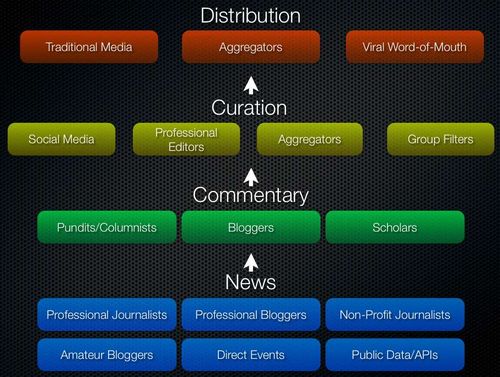
As new and unexpected methods of news delivery reveal themselves, systems of vetting and hierarchy will develop, and established journalism will find itself embedded somewhere in this news delivery ecosystem developed by Steven Berlin Johnson, one of the founders of Outsidein.
Our emerging newsrooms will be staffed in part by a generation of newshounds — yes, journalists — who’ve taken on the task of news delivery through the Web on their own.
You can learn more about this world of independent news bloggers at The Chicago Media Future Conference, a free afternoon event Saturday, June 13, put together by Scott Smith, a senior editor at Playboy.com, and fellow co-conspirators, Barb Iverson, teacher of all things digital and journalistic at Columbia College, and Mike Fourcher, founder of Purely Political Consulting.
Meawhile, read on. I talked to a sampling of these entrepreneurs and here’s their review of the current “State of Pay” in Chicago.
The Beachwood Reporter
Steve Rhodes
“We just added a fantasy sports columnist,” says Steve Rhodes, editor and publisher of the Beachwood, “in addition to a new horse-racing correspondent and auto-racing correspondent.”
“We just posted another YouTube parody song, Wee Love Q by Green Bay Bill, Tom LaTourette and Joe Dillo. It has already been played on the radio.”
This follows a notable success. The Society of Professional Journalists in April honored a joint investigation by Chicago Talks and The Beachwood Reporter with the SPJ’s 2008 national award for online investigative reporting by an independent media outlet. The Better Government Association assisted with the investigation into the activities of Chicago City Council committees.
“The award was nice because it is the second year in the row that we have won while working with (Journalism Professor) Suzanne McBride’s class,” Rhodes says. “If Beachwood can do this without any money at all, with just a little bit of money we could compete with the legacy media,” Rhodes says. “It’s not like the newspapers are the only ones who can do it.”
Named after Rhodes favorite Wicker Park bar, The Beachwood Reporter is unique among Chicago’s news blogs. Searing political commentary is Rhodes’ signature and the rest of the coverage — on music, TV, politics, sports, books and People, Places and Things — shimmers with humor and creativity.
Joining a stable of 20 contributors associated with The Beachwood are
new columnists Dan O’Shea on fantasy sports, Thomas Chambers on horse racing and Carely Lundin on auto racing. Each and every one is a volunteer.
Recently, Rhodes says, one feature is soaring in popularity: Ferdy On Films, a member site of the Beachwood Media Company, is getting 40,000 unique views per month.
Windy Citizen
Brad Flora
“WindyCitizen’s front page is a snapshot of what is new and most interesting in Chicago right now,” says Brad Flora, editor and publisher. “It will all be local and it will all be interesting.”
Flora was one vocal guy at the Chicago Journalism Townhall in February. We won’t repeat what he said, but it was passionate and angry. He’s calmed down since then, and focusing on the business side of his site.
“We are very similar to a Digg or a Reddit,” Flora says. “It’s a people-powered editorial approach to pulling together the news of the day.”
As a crowd-powered front page for Chicago, on any given day Windy Citizen will feature local blogging, video, photos, news reporting that contributors have brought to the site. Flora says Windy Citizen has 42 blogs in its network, who are compensated by enhanced visibility. But none of them are PR writers, he said.
It’s a central place where links can be shared and content can be voted up and down.
“The stuff that gets the most votes floats to the front page using an algorithm,” Flora says.
He’s currently running a fundraising drive and he’s making some money. But the general state of money things?
“It’s been paying my rent and Ramen noodle bill,” Flora says.
New Communities
Patrick Barry
“We have some fermenting going on here and pretty soon the cork’s going to pop,” said Patrick Barry, an editor and writer at NewCommunities.org. “I hope that when the cork does pop it will unleash a bubbly cascade of champagne.”
Barry works with Gordon Walek to put out a suite of news sites that report on Chicago neighborhoods at Newcommunities.org.
Recently Walek and Barry launched NeighborhoodSportsChicago.org. They pulled everything together — reporting, writing and graphic design — and published it in 11 days.
“It was our latest experiment in trying to create new avenues for underreported stories,” Barry says. “We got decent traffic during that week.”
Built almost five years ago, New Communities sheds light on media-neglected Chicago neighborhoods and the organizing and economic growth going on in those places. It’s the kind of coverage that was the bread and butter of Chicago’s newsrooms in the days when newspapers were more prone to report on stories relevant to the entire demographics of a city instead of the top 50 percent income demographic.
The sites have sustained funding from the MacArthur Foundation, so unlike the editors of many news sites, NewCommunities editors and writers get paid for their original reporting. But still, since they are a nonprofit, their search for operational revenue is never-ending.
“I don’t want to simply pass on something from somebody else,” Barry says. “I want to create original content that is not provided anywhere else and provide some insight into why it deserves to be up there.”
“That takes work,” Barry says.
“I think people really have very little understanding of what goes into putting out news. The layers and layers of editing, reporting, graphic support and now technology support.”
Barry says NewCommunities coverage brings alive the language of community development in a powerful way.
“It’s allowed people to understand what community development means,” Barry says. “We just showed them by running stories and photos. You can touch and feel it a lot more rather than some theoretical presentation of comprehensive community development theory.”
Barry says the sites have been successful because of the vacuum they’re filling.
“The search engines saw the stuff immediately,” he says. And once they started publishing the sites, the neighborhoods got involved and started building their own grassroots sites.
“They realized that they could have their own voice,” Barry says.
Gapers Block
Andrew Huff
“We are soldiering on,” said Andrew Huff, editor and publisher of Gapers Block, a Chicago-centric Web publication providing information on news and events around town.
“We are looking for some new contributors in art. Our editors get a small stipend as an indication that we do want to try and pay everybody.
Chicago’s network of news bloggers is “definitely collaborative, and extremely supportive, but unfortunately that doesn’t translate into financial success,” said Huff, who launched Gapers Block six years ago.
And that’s what’s holding everybody back.
“I believe that the future of journalism is a whole bunch of little sites,” he said. “The newspaper isn’t being destroyed. It’s being exploded.”
And everybody is flying out and doing their own thing — pay be damned.
“In the past, newsrooms were considered to be almost a community utility,” Huff says. “But since investors started expecting ever-increasing returns, the money equation for newsrooms hasn’t made sense.” In the old days it was a stable profit, not an ever-increasing profit.
“I don’t think money people know how to make money with news,” Huff said. What does that mean for Huff who writer for business blogs to make ends meet?
“If I left, the site would die,” he said.
Community Media Workshop
Gordon Mayer
Thom Clark and his Community Media Workshop are making a list and checking it twice to understand what is happening in Chicago’s online news streams as part of a Chicago Community Trust project.
“One of the things that we are doing is building a list,” says Gordon Mayer, vice president. “We know how to do directories.”
“We found 70-80 solid online news sites. There are a couple of questions about what does and doesn’t fit into this category. That’s what’s going to be in the report,” Mayer says. “It’s basically impossible for a single organization to come up with an authoritative list.”
Mayers says that In looking at newspapers, “what really shifted was their mission of who they delivered information to. The audience shifted from everybody in Chicago to an audience that was more monied.”
And the Internet is clobbering newspapers because of it, Mayers says.
The Community Media Workshop’s portal opens into a plethora of channels aimed at assisting nonprofit communicators and others who want to connect with the legacy broadcast and newspaper press. Its NewsTips service offers insight into the kinds of stories nonprofits are seeking to place in the press.
The CMW is doing the report for the Chicago Community Trust and planning to build its own newsroom, Mayer says.
CMW’s annual conference June 9-11, Making Media Connections this year on June 11 includes a session on social media and the news that’s free. But if you want to attend anything else at the conference the cost is $95 for the half-day workshops and $190 for full-day workshops.
Read More: Andrew Huff, Barb Iverson, Beachwood Reporter, Brad Flora, Chicago Blogs, Chicago Media Future Conference, Chicago News, Chicago Newspapers, Community Media Workshop, Future Of News, Future-Of-Newspapers, Gapers Block, LISC New Communities, Making Media Connections, Mike Fourcher, Patrick Barry, Scott Smith, Steve Berlin Johnson, Steve Rhodes, Windy Citizen, Chicago News
Who’s got the audience? Blogs or legacy
Are legacy newspapers for wealthy, older people? How will the next newsroom emerge from blogs? Here’s a discussion on the epicenter of news innovation. What pieces of legacy journalism will survive in the transition? How will paper continue to be distributed? I advocate a social enterprise NowNewsroom(L3C).
L3Cs on Chicago Tonight
When the Chicago Sun-Times declared bankruptcy March 31, 2009, I discussed the future of Chicago’s newsrooms on WTTW’s Chicago Tonight with colleagues Chi-Town Daily News Editor Geoff Dougherty and Northwestern Digital Media Professor Owen Youngman. They made some great points about what is to come here and I made a few points about the L3C business model and the Chicago Newsroom of the Future. Here’s the clip.
I also mentioned the L3C and Chicago’s Newsrooms of the Future on a segment on ABC Channel 7 News.
The Emerging Ecosystem of News Delivery
Steven Berlin Johnson over at OutsideIn, which I wrote about in June 2007 for the Chicago Sun-Times, brought wonderful clarity to the situation of legacy news operations yesterday at a presentation at South By Southwest. He envisions an evolving news ecosystem and with clarity places newspapers as a foundational gathering operation. He also cautioned that it is important to move forward to a vision rather than cling to the old.
But in times like these, when all that is solid is melting into air, as Marx said of another equally turbulent era, it’s important that we try to imagine how we’d like the future to turn out and set our sights on that, and not just struggle to keep the past alive for a few more years.
Steve says so well what I have been stumbling around trying to articulate here in Chicago. In evidence of the beauty of the Web, I was able to read his comments and see a video of him presenting the day after he did it – glorious access to information!
At a Poynter Institute event here in Chicago yesterday, the reality Steve describes was coming sharply into focus in the discussion. It is so sad that newspapers and some other legacy media do not see the preciousness of their brands and how important it is to preserve THAT so that they can have a place in the new ecosystem. Could be that they think their brand is a logo and marks, not something organic that emerges from the way that they operate.
Newspapers don’t need to go more deeply into the “swamp” of disinformation or useless eye candy to have a role in the new forest. They need to do a LOT more of what they do well — good local reporting — and spread cooperatively through their value systems to work with partners. Unfortunately, some newspapers like the Sun-Times where I used to work have been sucked dry of their newsroom resources by their business operating model. The Sun-Times is operated by a hedge fund, and all it wants is a dollar return. Hedge funds don’t value one bit the social return that is evident in a well-done newspaper newsroom.
It’s one reason why I am on the soap box for theL3C hybrid for news businesses. It’s great to hear Steve’s vision and here in Chicago, many of us are working to develop a healthy new ecosystem. Below is Steve’s flow chart for news delivery. You can watch a video of the presentation here.