Bikes are the new muscle car

Me and my Bridgestone 1993

Sally’s World, February 2003
www.worldwit.org

Update: Much has changed since I wrote this post about muscle cars in 2003. What’s changed for the best that heartens me the most is that more and more folks ARE riding bikes as  primary transportation. When I wrote this Chicago was not considered a cyclist friendly city.  In my time working for Mayor Richard M. Daley, a project to improve the Bicycle Path that runs from the north side of Chicago to the south side was being passed around the mayor’s office like a hot potato – some mayoral aides even ridiculed it. I didn’t. Being a frequent bike commuter, I thought it was great. I’m proud of what Chicago has done so far. We even have bike sharing in Divvy, although we need clearly defined bike lanes downtown for it to be truly useful. 

By SALLY DUROS

The play “Lysistrata” has been on my mind a lot lately with war and International Women’s Day fast approaching. So I was surprised when I punched the word, Lysistrata into Google and saw that a global protest was to take place March 3 with almost 800 readings of the ancient play scheduled for performance in 43 countries. For those of you needing a refresher on your classics, in Lysistrata Athenian women barricade themselves in the Acropolis and go on a sex strike to force their husbands to vote for peace with Sparta. It’s a comedy, with one of the main characters being the visible manifestation of male lust on stage. What that means I’ll leave to your imagination…

I’m guessing that folks were more lusty back then than they are today, and I’m not sure that the approach of the Athenium sisterhood would make a dent on our males of today. Take their remotes away -hear the pain! Or to be even more forceful – take away their muscle cars!

This occurred to me when I was looking at the Hummer ad on the back cover of Business 2.0. In the photo, the Hummer looks overpowering, strong and virile — it’s a mensch of a car glaring at me with mean headlights. “Search Engine” – the ad copy reads.

This is an intimidating car, and it’s for the man, OK — person, who wants a powerful image. Evidence abounds that these images make a big difference in the way we treat each other.

For instance, a study conducted in San Francisco found that a prestige car parked at a green light was treated with patience and care, while the economy car in the same situation was scorned. Two impatient drivers even rammed into the economy car.

For the past decade or so, it has taken a lot of debt to create the impression of being an important person of today. But these values are shifting – from being “important” to being “responsible.” And women are leading the shift.

I’m thinking about my sister, Mary. She’s got a thing about cars like the Hummer. Her thing is so strong that last year she bought a Toyota Prius, one of the new hybrids that combines the conventional engine of a gas powered vehicle with a battery and electric motor. They can get twice the fuel economy as a regular car. But the elevated mpg is just a pleasant side effect. The car itself was designed to greatly reduce emissions not increase gas mileage.

The Prius is the car that has taken Hollywood by storm, so my sister is in the same club with Leonardo DiCaprio and his family. Now, THAT’s a car that others salute at the intersection.

In fact, it is women like my sister who are using their purchasing power to create a market for the new hybrid technology. Research by Automotive Digest found that 35% of women say they would strongly consider buying a Toyota Prius, Honda Insight or another hybrid. Men show nowhere near that level of interest.

It’s not only the purchasers but also thought leaders and influencers who are fortifying this budding market. The Association of Women Automotive Journalists (WAJ) selected the Honda Civic hybrid propulsion system as the Best Automotive Feature in a 2003 vehicle.

In announcing the award, Jean Jennings, Chair of the nine-member WAJ Steering Committee and Editor- in-Chief of Automobile Magazine, told the audience: “The WAJ Awards, for the first time ever, have given us a strong voice, enabling women to clearly communicate our expectations to those who want our business.” To control possible conflicts of interest in the voting, women journalists associated with automotive manufacturers, suppliers or dealers were not allowed to vote.

While women will put their money where their values lie – their interest is directly tied to concern over the environment and the lower emission levels of hybrids – men adopt a wait-and-see attitude. Marketers say men are looking for proven performance and potential resale values as the design becomes integrated into the marketplace. Which is a nice way of saying women buy responsible while men buy sex and power.

I’ll admit when it comes to cars I’m an extreme case. I’ll never forget the car conversation I had with my boss, the Big City Mayor (Mayor Richard M. Daley) a few years back – this was before he was the “bicycle Mayor.” Mister Mayor was saying that a person’s car served pretty much the same function as a person’s appearance, and that you could tell everything about a person from their car. I knew this was in large part true, and I was feeling invisible — I didn’t know how to tell him that I “drove” a purple Bridgestone cross-bike and had never owned a car.

I know few Americans are going to trade in their cars for a bicycle. (Today in 2013, that’s changing – thank goodness! ) The next best thing is to put consumer pressure on the auto manufacturers to build responsible cars. After all, many of us spend so much time in our cars that we might as well live in them. I read recently that the average car driver will work twenty-seven hours each month paying for the thirty-two hours per month spent driving, and that during her or his lifetime the average car driver will spend more than $400,000 on a car’s gas, upkeep and repairs.

In an effort to appease tree huggers like me, President George W. Bush, in his State of the Union address, proposed $1.2 billion to develop hydrogen powered cars. That reminded me of Bill Clinton. Clinton and the big three worked together to develop the Supercar, which was supposed to get 80 miles per gallon. A recent Chicago Tribune Special Report said the federal government spent $1.5 billion, and the car companies spent just as much, but the car got canned after the 2000 election.

According to the Tribune, the U.S. Energy Department considered hydrogen cars then but decided it would take 20 to 35 years to get them on the road. And the cost of the new fueling infrastructure would have been astronomical. I guess Bush’s team has figured out some way to get around all that new infrastructure cost?

To date, about 36,000 hybrids are on the road in the United States, most of them Toyota Prius’s. That’s small potatoes when you look at the volume of cars built or sold in the United States annually – around 18 million a year! The cars carry a sticker price of about $20,000. Honda also has the two-seater Insight, and has just introduced the Civic hybrid. And Ford will be offering a hybrid, the Escape, this year. Buyers of these vehicles are eligible for as much as $2,000 in federal tax credits.

So I’m looking at the Hummer ad and wondering how long it will take for the US auto manufacturers to shift gears. The muscle cars are heading for extinction in today’s environmental and political climate while the new trendsetters are in hybrid technology. The hybrids may not be the perfect answer, but they can make a big difference in the way America lives in the world.

Me, I’m hopping on my Bridgestone to catch a free performance of Lysistrata in my neighborhood – can’t wait to see the costuming!

You can learn more about my sister’s Prius, the Elektra, and her other Prius friends at her website www.maryduros.com.

By the way, the opinions presented in Sally’s World are mine and do not in any way represent those of WorldWIT. I invite your rage and your praise. Email me!
Women blow whistle on conflict and cause growth

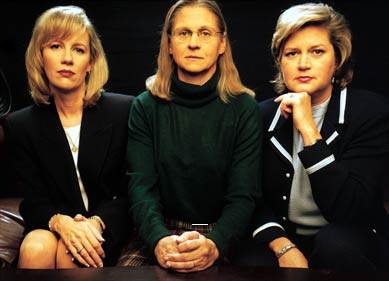
GREGORY HEISLER FOR TIME THE WHISTLE-BLOWERS: Cynthia Cooper, WorldCom; (left to right), Coleen Rowley, the FBI; and Sherron Watkins, Enron

Sally’s World, January 10, 2003
www.worldwit.org
Did you see that TIME Magazine chose three women as their persons of the year? Sharing the honor are Cynthia Cooper of Worldcom, Coleen Rowley of the FBI and Sherron Watkins of Enron.

On its cover TIME dubbed them “The Whisltleblowers.” In the photo, the three women look at the camera straight on, stern-faced, arms crossed, silhouettes dramatically lit, their hair framing their faces like haloes. They look annoyed, a bit like moms who’ve caught their 10-year olds throwing firecrackers at each other in the basement.

The photo portrait of this triumvirate doesn’t exactly fit the formula of what we think of as “out of the box” thinkers, but that is precisely what they are. To think out of the box is to be truly radical. It’s not simply to zig when you see a sign that says “zag,” but to blaze with a light that signals a whole new direction. It’s a risk and it’s a signal of what’s to come.

And in stepping out of the box, what did these three expose? Conflict, pure and simple. The conflict between what their organizations said they were doing and what they were REALLY doing.

I understand why TIME called them whistleblowers, but the term can be seen as, well, negative. It brings to mind other words like snitch and disgruntled. None of these women went to the press. The press went to them when their internal memos were leaked. None of them had an ax to grind. They all loved their jobs and believed in their organizations. As TIME says in its report, they are more like “the truest of the true believers.”

If not whistleblowers, then what to call them? These three “Persons of the Year” wriggled just as uncomfortably with being called heroes or role models.
Here’s a proposal: Let’s call them a harbinger.

And here’s why. Like the first robins of spring, our “Persons of the Year” are a signal of new growth to come in the cultures of our organizations.

If you read the TIME reports about what they did and why they did it, you will see that they were motivated by a desire to help their organizations to succeed and grow.
If this succeed and grow motivation sounds like a “chick” thing to you, well it has for a long time considered to be so. But since these women are a harbinger, it won’t be a “chick” thing for long.

The fact that they stood up could be a sign of an opening in our business organizations of benefit to all of us – men and women and future generations of employees. If we look beyond the headlines and read the subtext, this story is about how people – men and women alike – are driven to connect with each other in mutually enhancing relationships – inside and outside of organization.

It’s an opening that’s been a long time coming and was effectively advanced by Jean Baker Miller in her book, Toward a New Psychology of Women. Penned in 1976 at a time of dramatic change for women, this work is, in my layperson’s opinion, a work of remarkable clarity and brilliance.

Baker-Miller recognized that, socially, women through their activities carry human essentials that are not valued. Of these, the most important woman’s life activity is participating in growth fostering relationships – the process of acting in relationship with another person so that person can develop and grow.

This is the everyday stuff of rising children, and it is often described as nurturing or mothering. But these are gender-based words that negate the fact that all people – men and women alike -want to participate in growth-fostering relationships. Baker-Miller and her colleagues call this mutual psychological development and they say that it is essential to all of life and functioning.

So where do our whistleblowers/harbingers fit into this?

These three were so driven to foster growth within their organizations that they risked the conflict to make the growth happen.

Because women are usually subordinates, they do not actively engage in conflict with their dominants – their bosses. When the conflict is forced underground, it becomes covert, distorted and saturated with “destructive force.” But conflict doesn’t have to be that way, and by it’s nature it is not.

Conflict is actually good for us. Entered into with integrity, respect, confidence and hope, conflict is the source of all growth. “The infant would never grow if it interacted with a mirror image of itself,” Baker-Miller writes. “Growth requires engagement with difference and with people embodying the difference.”

28 years ago in her book, Baker-Miller called on women to reclaim conflict.

That is exactly what the ladies of the harbinger have done.

Their actions show that we have learned at least that much – that some conflict is necessary if we are to grow. Twenty years ago, these three would have had neither the position nor the means to even ponder a conflict. The fact that they stepped forward is a very good sign.

It’s not the end of the road but a beginning. For a long time, many of us have questioned the values of our institutions. We have looked for evolution to a more responsive organization that is more tolerant of authenticity. There’s been a lot of dissatisfaction but few guideposts to the next destination. Many of us have wondered how we have gotten into this mess and how we will get out of it.

“One adopts measures in keeping with his past training–and the very soundness of this training may lead him to adopt the wrong measures. People may be unfitted by being fit in an unfit fitness,” said the noted theorist of rhetoric, Kenneth Burke, who Baker-Miller quotes in her book.

That’s good for a giggle and it’s also true. Our three harbingers have pushed back against the “unfit fitness.”

With a little luck, they have cleared a path and planted a tiny seed for a new type of organization, one that is geared toward engendering authenticity and relationships of mutual growth.

And one that will allow us to have a good, clean fight when we need to.

What Business Bestsellers tell us

Sally’s World, October 2002
www.worldwit.org
By SALLY DUROS

I like to walk around in a bookstore and look at the new books and the bestsellers and browse the various sections. I like to see how and where the various types of books are shelved and what the latest trends are in size and design and color.

I’ll often just grab a bunch of books with intriguing titles and sit down. Thumbing through them, I’ll jot down any new catch phrases that I spot in a little notepad I obsessively carry with me at all times. Yes, I am the one who hogs the table at your Borders Books Cafe sipping one cup of coffee for hours, although as a good citizen I do return the books to their shelving section. People who work in bookstores don’t get paid enough to have to pick up after me. I am also hedging a bet with the fates in case some day a bookstore café becomes my place of employment.

This bookstore ritual of mine is one way in which I take the temperature of the times. From these visits, I can tell a lot about our collective mental health, about what is worrying us and about how we intend to fix whatever ails us.

On my last visit, one thing I noticed is that Michael Moore’s book Stupid White Men about George Bush and his business associates has for some time now been topping the New York Times Best Sellers Chart for Business Books. The release of Moore’s book was delayed last year around 9/11, and Moore was circulating an angry email at that time charging censorship. Whatever you think of Moore’s politics, he sure knows how to push his thumb into the center of the bruise and maintain pressure with great deliberation and zeal. This one has impeccable timing. Shipping this book as the Enron scandal unfolded was serendipitous genius.

Perhaps because of my somewhat checkered, on and off illustrious career, and perhaps because I am a business writer, I am often drawn to business self-help books. These books are a kind of guilty pleasure. I wouldn’t want anyone to think that I actually READ them.

You know the type. There’s usually a man or woman pictured on the red glossy dust jacket, body language denoting power, arms crossed, head tilted in challenge. The title promises to solve your burning career question of the day. You know, something like: “HOW TO AVOID BECOMING THE MAIN COURSE: Power lunching tips from 50
prosecuting attorneys.”

I am happy to report that my latest visit to this section cheered me right up. Usually these books are sold by some kind of game metaphor, or hunting metaphor or crushing-the-beer-can metaphor. You know, “You – snake, Me -crocodile – UGGH!” For a long time, there was a “Be Bad, Break the Rules and Get Ahead” metaphor. And this was especially popular among books geared toward women.

I really dislike these books because they discount the importance of culture, promote image above true values, and urge women to ignore their gut instincts. The 90s gave rise to corporate cultures of corruption and greed where office politics ruled, where so many of the behaviors urged in “Be Bad and Break the Rules” would actually maintain the status quo. I believe we have to hold true to what is right, push back and be heard if we are going to build businesses that are good workplaces for all of us.
I was cheered this last visit to the self help section because although one or two of these titles seem to sell into perpetuity, the wellspring for new books on this theme is drying up. Once again, it is Enron and the ensuing corporate scandals that have slain the “Be Bad” cliché.

All I can say is “Thank You, Sherron Watkins!” The Enron VP didn’t exactly leap, but rather was pushed, into the public spotlight. But still, she did a great favor for all people in business, but especially women. She was Brave and she told the Truth.
To fly so high at Enron, Watkins had to possess political savvy, superior intelligence and a tough gut. She knew what rules to break and what rules to bend. But in the end, what is remarkable is what she didn’t do: She did not remain silent. She spoke up – quietly – in a culture that above all valued glad-handing and backslapping and the rogue mentality (wink! wink!). The CEO and Chairman and top management team at the Crooked E didn’t listen. But the world did.

I also took the time for a second cup of coffee and to read “The Greed Cycle,” an article by John Cassidy in the Sept. 23 New Yorker that talks about how the “shareholder value movement” encouraged our corporations to go crazy. It seems we were so busy building shareholder value that we lost sight of what was valuable in our businesses and what was valuable in our selves.

So “Ta! Ta!” to books with titles that pair “Bad” and “Business.” And so long to business philosophy books that endorse image over substance. Instead I see an upward trend in titles using the words “brave” and “authentic” and gasp! “honest.”
Maybe we will all start learning things worth knowing again. Like how to develop products that meet a real need. How to sell these products to customers. And how to make those customers so happy that we ALL make a profit! Maybe we will get focused
on making an honest living again!

So my visit to the bookstore tells me that we still need time to recover, but I am optimistic. The business bestsellers tell us we are well on our way.

Sally Duros is a writer, editor, producer and communications consultant.

Brian Solis: What the C-suite can learn from connected consumers

[media-credit name=” for Chicago Tribune 435 Digital.” align=”aligncenter” width=”668″][/media-credit]OK. I’ll admit it. I have a Tiger Beat crush on Brian Solis. That’s because Solis is one of the smartest people around when it comes to social media and its power to reshape our world.

Solis has been in technology public relations since 1991. He began working with message boards, communities and early blogs in the 90s and started his own firm, FutureWorks in 1999. In March 2011, he joined Altimeter Group, a research-based advisory firm that says it offers “pragmatic strategies to help companies thrive with disruptive technologies.”

You can pop in on Solis blog, which includes a series discussing the concepts in his new book, The End of Business as Usual, or catch his insightful TV series, Revolution, on YouTube.

Solis has written perhaps the best book on online marketing for beginners, Engage: The Complete Guide for Brands and Businesses to Build, Cultivate, and Measure Success in the New Web. The End of Business as Usual is targeted toward emerging leaders, those change agents who want to revitalize the culture of business around customer experience.

Continue reading Brian Solis: What the C-suite can learn from connected consumers