This is my oldest brother, Ray. He’s in characteristic pose, balancing on an old tree limb, above a murky trickle of a creek in a Cook County forest preserve. Ray would scoop mud from the beds of waterways like this and keep it in a jar and watch with fascination what crawled and swam from the oozing mess.
Today would have been Ray’s 72 birthday. As it is, he lived to celebrate only 28 birthdays in his life. He died so long ago, my memories are simply sensory — an image, a smell, a feeling of gladness, happiness or comfort. I recall some key moments. Mostly I recall missing him and now as I look back on the spent years I see mostly how his living and his leaving changed me and changed everything in my family.
I see Ray in the basement, blowing up plastic models of WWII boats. He’d fashion flame and smoke out of cotton and stick it in the boat stacks and explode the boats with firecrackers in basins of water. And I see Ray bringing home crayfish to live in the basement sink. Ray deeply influenced my reading habits — it was because of him that I read Sartre at the age of 11 and other existential writers way beyond my level of comprehension. He would write creatively and it is probably because of him that I too wanted to be a writer.
Ray was a typical young man of the 60s. One day I and my preteen girl friends hid in my room devouring his Playboys. Behind closed doors, we each held up a copy, pin up unfolded in front of us and wiggled behind the images of full formed women, talking seductively in our squeaky little girl voices.
I recall that when he entered the living room at my parents house he would have the keys out and they would make a jingling noise. He would wash the car with suds on Saturdays and wore a varsity letter sweater from Lane Tech High School (we still have it). Ray loved all creatures without discrimination. I was terrified of spiders, and when I was a preteen Ray captured one in his hands and came toward me, hands folded closed, saying “Don’t be afraid – look! He’s more afraid of you …” I shrieked and went into a panic. It didn’t work. I still don’t like the creepy guys much.
There’s so much to say about Ray and the goodness of him and the sadness we all still feel that he left us so early. In many ways, as my parent’s first born, he was the promise of the family. Seven years older than I, he was the grown up I could talk to.
When I was ready to join the flower power movement at the age of 18 — it was Ray who tried to talk me out if it. I didn’t listen and I went to California with friends. The $100 bill in my shoe lasted only so long and I came home defeated about three months later. That dream was mostly over.
Ray was living on his own then, with a degree in marine biology from the University of Miami. He was married and worked at the same engineering firm as my dad.
I was still adrift in some ways, hungry to feed an adventurer’s heart, traveling out West and back repeatedly. Just three years after my first trip, I was camping at Yellow Pines, a backpacker’s camp in Yosemite Valley. For three days, sadness overwhelmed me during the two mile hike back and forth between the camp and Curry Village. I had called home every day but nobody picked up. Finally on a Thursday night, my baby sister answered. She told me Ray had died. I don’t recall what she said or her voice. I just remember the phone dangling from its cord where I had dropped it. I wailed under the moon, crying to the silver granite cliffs, then hitchhiked a ride to the Fresno Airport and took a plane home at midnight so I could attend Ray’s funeral the next day in Chicago on a steamy Friday, Aug. 13.
Those events changed my life so profoundly. I still struggle to see the path of events and the trail they left.
He left us in a mysterious way, and some day I hope to understand the truth of it.
Today on his birthday, I remember Ray and I remember the beauty of him and what he brought to all of us. I see the seeds of his short good life in the best days of my own.
His life was a rock in the river of my life and the lives of others who loved him. His presence changed the flow of events unpredictably and permanently.
Today on his birthday, I look behind and I look forward. I can see Ray balancing on this log with joy, in that moment, forever.
Originally published on www.worldwit.org — Liz Ryan’s social network
By SALLY DUROS
So we are caroling to the animals at Chicago’s Lincoln Park Zoo, and it’s quite a family affair with Santa Claus and humans disguised as reindeers and penguins, and earnest people singing holiday songs. There’s even free hot chocolate and cookies for everyone. But I am feeling disoriented because Santa Claus is being interviewed and he is talking about ‘time management.”
Time management? Give us a break! Whatever happened to holiday spirit? You know spirit like in sacred books and all the spiritual traditions of the world. NOT spirit like the car, the movie, or the gun. Santa, please say it isn’t so!
Some would say that spirit has been lost in the supermarket for a long time, and that Santa himself is one of those common signs of its impending extinction.
But I would counter that Santa originates from many great spiritual traditions of gift giving, and that spirit is actually ubiquitous. You’ll see it everywhere if you look for it. Even in business.
Like the cover story for Business 2.0 in November. In case you missed it, the topic was, “The Art of the Brilliant Hunch. Science is starting to understand why the best decisions come from the gut. Here’s how to make tough calls under pressure. ”
Boy, did I glom onto that headline. That’s because I know and you know that following the gut is always the best, but not necessarily the easiest, policy. When we ignore those gut feelings to do something one way, and we do it the other way and everything goes wrong and away from the direction of our intentions, we know the real bellyache is sure to follow. And our pain is amplified by the fact that we knew better!
The Business 2.0 article cites some interesting research on intuition. The bottom line, according to the article, is that emotions start the decision-making process, people are superb pattern makers, and we excel at abduction (rather than induction or deduction. Thank goodness for that because I never could keep those two straight.) The informed gut rules, the article said, in complex, complicated and chaotic situations, rather than in situations where formal rules can be applied.
Readers were also treated to several worthwhile capsules of how hunches work in business including advertising, publishing and broadcasting. My favorite factoid was that Howard Schultz, the founder of Starbucks, shook uncontrollably when he came up with the idea of Starbucks. (My hypothesis is that the shakes came not from the power of the idea but from psychically connecting with the future caffeine overload of a nation of office workers.)
It was s good piece of journalism, bearing good news and befitting a fine publication like Business 2.0. The argument was based on scientific fact and expertise, and I applaud Editorial Director Thomas A. Stewart for his persuasive case.
Seems to me, though, Stewart missed pinning the tail on the hunch by about a foot and half. That’s because so much of his argument was draped against that common worldview of business, where relations are assumed to be contentious, competitive and warlike. Yeah, business is like that sometimes, but does it have to be?
It’s in my nature to shift perspective and ask: What happens when we change the worldview from one of scarcity and conflict to one of plenty and affinity?
Then the real mystery becomes less about how we make decisions in chaos and complexity, and more about how we become attracted to and then passionate about an idea. And sometimes that idea – like Starbucks – has multi-billion dollar legs.
I say the beauty of the hunch is expressed most brilliantly in the creative act of bringing something new into the world.
It’s like that hunch I have that the Business 2.0 writer was picking up some energy from the cultural stew when he decided to research this article because, well, he had a hunch! Still, where did that genesis spark come from? How was he attracted to the story idea and how was it attracted to him? Pattern played a part, paycheck played a part and editors played a part, but none of these constitute the Velcro that sealed the deal.
I believe the answer is spirit, the spirit unique to each of us that brings specific gifts into the world. And, yes, the kind of spirit that has to do with looking at the world wide open, and asking,” I wonder ..? And yes, that holiday spirit that celebrates all that is good in life, and the way we are all, each and every one of us, connected with each other.
So, here’s a holiday invitation offered in the spirit of peace and new beginnings. It’s adapted from the writings of Sonia Choquette, a well-known spiritual counselor in Chicago.
The next time you are called into a meeting with parties holding close cards and disparate interests, ask yourself this question: “How are we alike?” And look for what is true and what is real. Most of all, trust what you discover.
Radical, I know.
And if you are feeling really brave, check your assumptions at the door. Even if you have worked with these people for 20 years, walk into the meeting with this one directive: Never assume that you know anyone. And during your meeting, listen to what your intuition is telling you. Really listen – deeply. And trust it.
And most of all, here’s an invitation to a different kind of time management.
Let’s stretch the time period for holiday spirit to 365 days of the year.
And make each day a celebration of what is unique in each of us.
I am here to announce that the business suit for women is alive and well and sitting stylishly (minus the shoulder pads, thank goodness) on the shoulders and hips of businesswomen the land over! That’s proof that I’ve been hanging round the tech world a long time with its casual dress everyday and its designer tennies and its quirky habits of eating and talking – artfully – at the same time. Don’t get me wrong – I love that quirkiness, but I have forgotten the feel of a DK jacket and a Dana Buchman silk – jeeze louise, I don’t even know if those brands exist any more and whether their equity has held up.
The fact that women in business still get dressed up and wear beautiful clothes that resemble those worn by Cokie Roberts rather than those worn by Madonna hit me like a Perry Ellis camel-hair topcoat when I attended a recent breakfast meeting of the University of Chicago Women in Business Alumnae Network her in Chicago. I breathed a sigh of relief that I had left my tattered backpack at home and brought my Tumi bag instead.
I had correctly anticipated the formal atmosphere. It was an event put on by The Executives’ Club of Chicago as part of their New Women’s Leadership Breakfast Series. The title was “Perspectives from Women Shaping the Future” and “The Challenge of Leading Change. ” It was great! We heard the scoop from Linda Bammann, Executive Vice President, and Chief Risk Management Officer of Bank One. We heard from Chicago Mayor Richard M. Daley’s Chief of Staff, Sheila O’Grady. And we got the viewpoint of Judith Sprieser, Chief Executive Officer of Transora. Then we had an excellent moderator in Elizabeth Brackett, Correspondent for WTTW and “NewsHour with Jim Lehrer.”
They said a lot of insightful things. But the bottom line was the usual “Managing change is difficult.” It was my turn to be incredulous – well “Yes!” I guess I thought the rock was a bit higher up the hill and the conversation might have advanced to a deeper level. But a panel discussion is limited in what it can deliver, and it’s a whole different story when you’re talking about light as a feather early stage start-ups vs. large organizations like our panel was discussing. I started recollecting a conversation I had a while back with a fellow who knows a lot about cultures and change – in both start-up businesses and Fortune 100 companies – Bob Okabe, principal of Illinois Partners and co-founder of Chicago’s Prairie Angels Capital partners LLC., the manager of the first organized angel fund in the Midwest. Bob has a grey suit pedigree in investment banking and corporate finance, holding senior leadership positions at Lehman Brothers, Kidder Peabody, and General Electric, among others.
Sally:How do you get to the authentic core of what your values are, so that you can build a business that will give you what you want it to give you? Obviously, you don’t want it to just be successful. You want to also have a business that you want to go to every day.
Bob: I think a lot of entrepreneurs just say, “It’s my business and I’m doing it my way, and therefore it’s something I want to come to every day,” but they don’t realize it’s not necessarily something other people want to come to. … Too many people hire for skills, not for culture.”
Sally: Can you talk about culture a bit more? About how it’s manifested in business?
Bob: Yes, I think culture is expressed consistently in one of two ways. One is by leadership, and the other is, you institutionalize it. I think it can be institutionalized. There are companies like SAS that clearly institutionalize it, and they foster a very particular culture or an attitude, and they build systems to make sure it stays consistent as the company grows.
“Then, there are companies that do it just by leadership. I mean, at GE Jack Welch had to do it by force of will, because the organization already existed. He had to fire people at this very senior level who were probably good at their jobs but didn’t fit the culture. He had to reward people who fit the culture but weren’t successful. And he had to stick by people whose performance was mixed. I think he basically did it by force of will and leadership; so you can do it in either way. The question is, what is easiest for you.
“I think in a small company, by its nature, it is going to be done by force of will, by leadership.”
Sally: Well, yes; you would say, “This is what I want.”
Bob: “But you know what? A lot of entrepreneurs – a lot of raw startups put together their team by who’s convenient and who’s willing, not by who’s right. …I see lots of teams where it’s a bunch of guys who knew each other. ”
Sally: Do people hire from skills versus culture because it’s easier to quantify skills than culture?
Bob: I think first of all that people hire in the following order: skills, personality, and then culture last. Really, what they should hire for is culture first, skills second, and personality last. Because the boat moves as fast as the slowest rower, so if there’s somebody who’s not motivated and not interested, I don’t care how physically able he is; he’s not going to row well.”
Sally: Have you gained any insight into office politics and how that affects an organization?
Bob:Office politics are a reflection of the culture in an office. People politic within an office if they feel they have to, or if they feel it will gain them a significant advantage over others. So people who are known as brown-nosers have learned and believe that office politicking helps them. And a culture that accepts that is a culture that breeds it.
But the reality is that if you’re working together, then it doesn’t matter. A consistent culture reduces the amount of office politics. I would argue that the more consistent an organizational culture is, the less onerous the office politics are.
Sally: That would actually make sense. Because if people understand the rules of how you work together, and they have enough guidance and understanding of that, then they won’t be bringing personal – you like me, you don’t like me, I like you, I don’t like you – into the mix so much.
Sally: You have to have some kind of good radar working to understand culture so well.
Bob: I think good entrepreneurs do.
The bottom line of our conversation was that Bob and I agreed that you can tell a lot about the culture of an organization by the way it talks about itself.
From my viewpoint, that talking comes in many forms. In dress codes, and hours kept. In lunch etiquette, and coffee time and water cooler gatherings. In please’s and thank you’s or growls and purrs. In office spaces and public gathering places. In email formats, and cc’s and bc’s and subject lines. In golf outings and take your kid to work days and family leave. In how you celebrate holidays and birthdays and days of important business events. In how you hire and promote and celebrate. In the stories the business tells about itself in the hallways, the executive offices, in the mailroom and in the media.
And all of these things will contribute to whether you’re wearing high-tops or floral pattern pumps to the office. As the old saying goes, “If the shoe fits, wear it.” Any type of shoe is fine as long as it fits you.
Leadership. We talk about it all the time. But what is it?
I’ve worked in places where leadership is measured by office configuration and size of paycheck, by number of phone calls placed and appointments made, by the urgency, authority and volume of voice with which one gives orders, by the minutes one arrives late at a meeting, or by the number of minutes of face time one has with the boss.
You know and I know that none of this is leadership, but sometimes it passes for the real thing when there is lack of an authentic leader.
Oddly, it was a photograph of an event in a far off place that got me to thinking about how we define leadership.
It was a news photo in the Sunday New York Times. Black and white, running over three columns at the top of the page, the photo was of about two dozen women – dressed casually in slacks, skirts and blouses -tossing handfuls of soil on what looked like a mound of dirt and rocks. The caption said: “Women in Dyararnakir, Turkey, performed a task customarily done by men when they threw soil on the grave of Cemse Allak, a stoning victim.” The headline on the article read, “Honor Killings defy Turkish Efforts to End them.”
The women throwing the dirt are members of KAMER, a women’s rights association. The woman in the grave had lain semi-conscious in a hospital for seven months after her skull had been crushed. The man who had made her pregnant lies in a grave of his own. This is the way honor is upheld in a culture that believes that an unmarried pregnant woman, even if brought to that state through rape, has brought shame upon her family and merits a death sentence.
It appears Turkey has been trying to win its way into the European Union, and to do so it has passed human rights legislation that lawmakers hope will squelch the tradition of murdering in the name of “family honor.” As many as 5,000 women and girls are murdered by family members each year in so-called “honor killings” around the world, according to The United Nations Population Fund.
Turkey’s legislation is necessary, but it won’t mean squat without grassroots leadership like that provided by the KAMER women who visited the stoning victim in the hospital, claimed her body, and saw to it that she had a coffin and a burial. They supported her when her family wouldn’t. Research on “honor killings” has shown that females in the family – mothers, mothers-in-law, sisters and cousins are commonly complicit in the violence and support attacks and “honor killings.”
Given Turkey’s cultural context, the actions taken by the women of KAMER is clearly an act of leadership.
Given the “Western” cultural context, what I see in this news story is that time is right for each of us to take personal action to disarm the weapon that enables ancient practices like “honor killings.”
That weapon is gossip.
Women value connection to others more dearly than anything else, research over the past three decades has found. And because of that, gossip hits hard as a stone and fells even the strongest among us.
Women attack each other constantly, covertly and vigorously, indirectly through gossip, slander, shunning and bullying. Still, that isn’t as aggressive as what men do – or is it?
The ways in which women attack – dubbed indirect aggression by psychologists – are devastating to individuals. Women mostly target each other, and in some cultures the attacks are deadly.
Yes, men’s typical aggressive choices – fighting, guns, bombs, weapons of mass destruction – are designed to kill and maim. This kind of aggression is open and endemic. We discuss it and actively take sides on its presence in the world. But woman’s way of attacking indirectly allows us to trivialize, minimize, and hide the way we hurt each other.
Indirect aggression has a profound affect on the status of women in the world. It is the main expression of women’s sexist beliefs about ourselves.
I can almost see the eyes rolling here – NOT another call for political correctness! This is a bit of a mind twister so please bear with me. This is absolutely not political correctness. There is no code of behavior. No checklist of approved attitudes and behaviors. Nor should we consider taking the short cut by imitating men’s worst behaviors.
No. We have to find a new way.
There is instead only the requirement that we be real and respectful and speak our minds, that we learn to let go of our anger and envy, that we refuse to participate in mutual downgrading.
Women are sexist. We are programmed to work against and undervalue ourselves. Indirect aggression is the method we use to keep each other in line and maintain the status quo. And the status quo does not serve our goals. The status quo seeks to keep us less visible.
This is a dirty old secret that was never really a secret and that has finally been thoroughly addressed in Woman’s Inhumanity to Woman by Phyllis Chesler, a groundbreaking feminist psychologist and author. Chesler says that the book took her 21 years to write, and during most of those years other women begged her not to write it.
In the Introduction, Chesler says: “As feminist women, we knew that we were doomed without sisterhood so we proclaimed it, even in its absence. We wanted to will it into existence, verbally, without wrestling it into being.”
Those of you tempted to browse to the next page because of the word “Feminist” – please don’t! This book helps us – it helped me at least – to understand and recognize the attitudes that I have internalized and how they are hobbling my power in the world.
The book is exhaustively researched. Chesler provides evidence from primate and anthropological research, workplace studies, sociological data, original interviews, memoir and more to make the case for woman’s inhumanity to woman. She discusses indirect aggression among girls and teenagers, between mothers and daughters, sisters and best friends, women in the workplace, women in groups, as well as personal examples from the women’s movement.
And yes, Chesler offers examples from research that demonstrate how women’s gossip creates the climate in which “honor killing” of a woman can become inevitable.
Although women in the West are leading the way on many fronts our advancement is hobbled by these dynamics.
“Women in the family face life and death battles, and we transfer those into our worklife,” Chesler says in a telephone interview. “It would be better if women could learn to take things less personally. … keep our eyes on the prize.”
“Women are the chief enforcers of this (aggression),” she says. “Men do not notice it.”
There’s a lot of information in this book, and it’s tempting to make it an intellectual exercise. We shouldn’t let that happen. The bottom line is personal and in our hearts. It takes us beyond rhetoric and thought and to a place where we each, as individuals, can recognize our everyday sexist assumptions about ourselves and other women.
I encourage you to read Chesler’s book to fully experience the passion and clarity of her argument. As Chesler writes, “I no longer share as an article of faith the belief in the power of political-social programming to improve human nature. … I am suggesting that the human spirit has the power to learn from adversity in remarkable ways.”
The spirit does. To push back and expand our personal edge in the world causes discomfort. But it also forces learning. And that learning can bring change around the world.
In Turkey, the change is under way at the legislative front and at the personal front. That Turkey even cares how it looks to the European Union and the “Western” world is the result of the personal work of millions of individuals and, in turn, institutional response to that work, during the past several decades.
Those of us in WorldWIT can help write the headlines of the next decades by taking leadership and fine-tuning our ear and our actions so that we are acting openly and authentically as woman and as individuals.
Each of us can heighten our awareness and then, before you know it, we’ve jointly created a critical mass of consciousness that will take us to the next level. That’s social change.
It is in that spirit that I offer Chesler’s 9 suggestions for how women and daughters can accept, sense and be with ourselves and one another to create a fresh perspective.
1. “Humbly accept that change is a process.”
It can’t be rushed.
2. “Acknowledge, do not deny the truth.”
Women are normally aggressive, oppressed women are angry; be realistic about what to expect from other women.
3. “Become strong.”
Develop a strong sense of self and of your uniqueness.
4. “Become strong enough to take criticism.”
Hear respectfully. Opposing views are not a personal betrayal.
5. “Learn to express your anger: rules of engagement.”
Perhaps here we can learn from men, who comfortably occupy a psychological middle distance from each other.
6. “Learn to ask for what you want: Learn to move on if you don’t get what you want.”
Put it into words and ask for it directly.
7. “Do not gossip. ”
Do not initiate it and do not pass it on.
8. “No woman is perfect: apologize when you’ve made a mistake and then move on.”
If you are the saboteur, cut yourself some slack. If you are slandered or sabotaged, deal with it directly.
9. “Treat women respectfully.”
Cultivate the concept of an honorable opponent.
By the way, the opinions presented in Sally’s World are mine and do not in any way represent those of WorldWIT. I invite your rage and your praise. Email me!
Lately, those who make a living as pundits have been busy clicking and clucking and clattering keyboards and uttering bellicose profundities about one, single-syllable word: Facts. The questions about fact morphing into fiction float and bob about like so many balloons buoyed by the media winds.
Me – I’m not chasing any balloons because I take as fact very little of what I read or see broadcast in any of the media streams. I am one of those people who thought the Barry Levinson film, “Wag the Dog,” was a thinly veiled documentary.
Instead I ride the media currents to see what is bobbing on the horizon of the public mind. What’s happening today is a simple matter: The media soufflé has flattened and with the collapse of the puffery – within corporations, government, and media outlets – we are rushing to fill the void. I’m enjoying the “whooshing sound,” and looking forward to seeing what kind of omelets we’re left with.
Label me wacky or label me a cynic (perhaps both!), but for me a fact begins with that which I can personally touch, see, smell, taste, and hear. I then apply the gut test – my intuitive sense – to create an impression aligned with my value system, cultural wants and spiritual beliefs. Some of my criteria are tangible and some are intangible. And then, when I’m done I still don’t have a fact. I have my belief. One of my core beliefs is that we are all – each of us – a spinmeister of sorts.
I liked the tale that was being spun by master storyteller Judy Wicks, owner of Philadelphia-based White Dog Cafe, co-chair of the National Business Alliance for Local Living Economies (BALLE), and chair of the Social Venture Network (SVN). She was speaking at a kickoff meeting for a new organization here called Sustainable Chicago.
Wicks says that upon waking every day, she looks in the mirror and says: “Good Morning Beautiful Business.” You have to like a woman who has two cabins in the woods, one named “Happy House,” and the other named “Fart Freely.” What began as a home-based coffee shop in 1983 is now a restaurant that seats 200 and grosses $5 million a year, with a commitment to fun, food and social activism.
What was most persuasive about Wicks was that her tale came right from her heart. I could tell because I had heard it before – from entrepreneurs of all political stripes and others involved in building local economies. That is, that business is really about relationships, relationships with certifiable, verifiable, living, breathing real people.
“A large factor in our success is that we are a real community-based business,” Wicks said. “We share values with our customers.”
“Living and working in the same community has given me a great sense of place, which is really important for building local, living economies,” Wicks said. “When you work and you live in the same place there is a very short distance between decision makers and the person who is affected by your decisions because every day you see your customers that you serve, every day you see your employees that you work with. And you live in the community and you see your neighbors (and the impact of your decisions.)”
That’s the kind of real world fact-checking that resonates for me, and helps me spin my personal vision of a perfect world. It also occurred to me that that’s the kind of fact-checking you get, and you can create through your local WorldWIT email discussions and real world events.
WorldWIT was ahead of the game in understanding that the strength of the new email tools of the web could help women with a friendly point of view, women from the same work/life integration tribe, women in the same cities and regions, share information with each other, and then create real world networks.
When you post a question to a local discussion list, like ChicWIT, you can receive a dozen or more replies. You can pick and choose what information to follow up on based on your own criteria. Even better yet, you can attend a networking event and meet the helpful individuals who communicate with you through the lists. And if something happens and you have to change jobs and move to another city, you can use the same WorldWIT resource to check out your new hometown.
Before the rush to make the Web a commercial force, there was a web that was a community of people. Hobbyists and techies and those who were simply curious built the web by putting up special interest sites, basically as communications tools that said, ” Hi, there – look what I’ve done!” That was about it. If you were on the web around 1995, you will remember when Yahoo was just a page of favorite links, a daily record of what was new on the web, put up by a couple of guys who thought the information-sharing was really neat. It was a community, and the sites were places where like attracted like, where you could find your tribe.
During the days of the dotcom gold rush, some of us lost site of the tribal energy because some financial wizards got the idea that there was money in huge global markets and numbers of eyeballs. Perhaps there is. But in my opinion, that is not the richest or deepest well.
The under tapped frontier is the landscape occupied by WorldWIT, where the locals knock on each other’s doors to find the answers to the burning questions of the day, the answers that simplify our everyday lives.
When we send our request to the WorldWIT universe, we are inviting friendship and collegial exchange. We are building trust and creating relationships. We – friends, neighbors and colleagues – are finding and becoming trusted sources for each other. And that is a great way – and the only way – to do business with each other. And that – to me – is a fact that I count on.
There’s a book I have to read. It’s called The Organization Man. It was written in 1956 by William Whyte, and it’s about time that I learned what the book says.
When I was a girl, I held a secret deep and true, and that was that somehow even though I was female I would grow up to be an “Organization Man.” My dad was an Organization Man, and my best friend’s dad was an Organization Man, and the kids’ next door, their dad was an Organization Man.
I wasn’t sure what it meant exactly – It was just a book laying around our house – but I knew my dad was one, in my simplistic view because he wore a hat, and a suit, and he went to work downtown every day. My dad would leave the house at the same time every morning. When the weather was warm he would walk to the train. You could hear the screen door slam. I would sometimes watch him exit, impressed by how fast he walked. It was a mile-and-a-half to the commuter train that took him to downtown Chicago where the train belched him out with thousands of other people, and they all walked with great intention and urgency to the gleaming revolving-glass doors of the skyscrapers where they worked, engaged in their important missions of commerce and building things and selling stuff. I knew about that because he would bring me downtown with him a couple of times a year to show me off to the other civil engineers he worked with.
His route home led him like clockwork every day, up the side streets of our north side Chicago neighborhood, until he hit the end of the alley on an adjacent street. Which is when I would spy him coming around the corner, and I would run fast up the alley and jump into his arms, the dependable arms of an Organization Man dad, and he would carry me back to my mom, and siblings and the house, and it was nice and cozy like a TV sitcom.
My dad brought home the scent of ink, paper and concrete, and his face felt rough at the end of the day, and I liked that. He carried a briefcase, and he often had work to do in the evening.
Although I couldn’t read the book The Organization Man, I knew my dad was one. Nearly all the dads I knew were Organization Men, except Mr. McHenry, and he owned his own business, and that seemed very strange and mysterious, and he was around during the day and even had a small disassembled airplane in his back yard, which was very exotic and alien.
I was reminded of these childhood memories when I was chatting with Penny Pickett, Business Director for the Telecommunications Development Fund, at Springboard 2003-Midwest, the women’s venture capital forum. Penny was talking about the changes she has seen in the way businesses are viewed since she had started her own business first in 1980.
She started her business in 1980. When it was initially based in her home, it might solicit a condescending comment and a pat on the head. But when men headed to their garages and their basements after businesses embedding the culture of “The Organization Man” had mass layoffs during the 1980s, the conversation rose to another level. That’s when the descriptive word “entrepreneur” emerged.
A basic tenet of The Organization Man was the idea that an employee gave the corporation loyalty and, in turn, the corporation took care of you. Some folks referred to that disparagingly as corporate welfare. The book proposed that employees would have 20-, 30-, and 40-year careers with one corporation.
When my dad started working for the organization, it had about 60 employees based in Chicago. When he left, the company had about 700 working worldwide. When the company merged with another two years ago, it had about 1200, still a small-to-medium sized business by most measures.
My dad retired from the organization nearly two decades ago, with 35 years under his belt. His company merged with another one two years ago, but still the company sticks with its tradition of inviting every one who ever worked for the company to the holiday party. My dad still sees many of his colleagues from the old organization. He can thank the organization for financial stability for his family, a lifetime of friends, and work that challenged him and he enjoyed. My dad says that it was a pretty good deal.
The downside to being an Organization Man
If there was a downside to being an Organization Man, it was the spiritual demand the organization made on the individual.
“This book is about the organization man. If the term is vague, it is because I can think of no other way to describe the people I am talking about. They are not the workers, nor are they the white-collar people in the usual, clerk sense of the word. These people only work for The Organization. The ones I am talking about belong to it as well. They are the ones of our middle class who have left home, spiritually as well as physically, to take the vows of organization life, and it is they who are the mind and soul of our great self-perpetuating institutions.”
– From the book The Organization Man, William Whyte
As painful as the evolution has been, today we are seeking a spiritual anchor in work, and this has been especially liberating for dads. Today it is as common to see dads who are self employed as dads who are working for organizations. Dads and men, in general, once a rarity after school at playgrounds, are becoming increasingly common. Whether there by choice or because of a lay-off -most of them look pretty happy to be refereeing the basketball games, manning the tube swings, testing the jungle gym and toting the backpacks of their kids. That’s an experience that the organization never granted my Dad and other Dads of his generation.
If the organization doesn’t seem to have room for “The Organization Man” anymore, some of us have learned a new way to be in the world that means creating our own organization – even if it is only in our heads. This way of being isn’t easier. But Pickett says, we are nonetheless learning new behaviors.
“People today are more flexible and more entrepreneurial, even if they do go to big companies,” she says. “More people are biting the bullet and learning the characteristics of entrepreneurs.”
This brought to mind a friend of mine who has adapted the mindset of a contract employee, even though she is a full-time employee. Pickett believes that given the choice people like my friend would elect for a more comfortable work lifestyle.
One also shouldn’t confuse the heart-sets of a small-business owner and that of an entrepreneur, Pickett says.
“A capable business owner is the person who’s been pink-slipped and is desperate; they need an income,” she says.” They haven’t been able to find a job, so they start a company.”
“Small-business owners, we couldn’t survive without them,” she says. “They build good companies. They provide services that we all use. They’re important to their communities. They pay their taxes. They’re good people. They’re just not driven the way entrepreneurs are.”
“The entrepreneur is somebody who tends to be pretty bright, but tends to get fairly bored,” she says. “They like to learn new situations, but once they’ve done that they will get bored fairly quickly if it becomes routine. An entrepreneur has a real need to fix things, to improve things, to really change the world. Now money may be the thing that you keep score with, but in many ways, I don’t think money is the real goal.”
“An entrepreneur is a do-gooder who has a strong conviction that there’s something that they can do that’s going to make the world better or make people’s lives better or solve something that really is hurting a lot of people,” Pickett says. “They’d like to make money. That’s great, because in many ways, making a lot of money just gives them the cushion where they can flush out other ideas. It’s a vision thing.”
I look at it this way, if the small-business owner is the eagle on the U.S. seal, and the entrepreneur is the cowboy on the frontier, then The Organization Man should be honored on the face of our dollar bills.
Today, Dads are just as likely to be one as another, and Father’s Day is the time to honor all of them. Happy Father’s Day, Dad!
Recommended reading for this Father’s Day: The Organization Man, by William Whyte; Not Just A Living by Mark Henricks; Crossing the Unknown Sea: Work as a Pilgrimage of Identity by David Whyte; and Sacred Hoops by Phil Jackson.
First Published in Sally’s World, April 2003 www.worldwit.org
By SALLY DUROS
In the 80s, we worked hard. In the early 90s, we worked smart. In the late 90s, we worked fast. But now, firmly established in the first decade of the new millennium, we are working all three, but most of all we are working passion.
Today many of us have switched careers or spun out of traditional organizations into smaller more intimate ones – maybe even our own. It’s a realignment of values – we are giving up what doesn’t matter for what does matter. In seeking to live from our hearts in our work and personal lives, we are responding to the irresistible tug of passion.
When passion is present, we don’t stop simply because something goes wrong. We feel the pain, yet we keep going. Having passion doesn’t mean that we will succeed. It simply means that our endurance and resilience are boosted by the power of our authentic presence. Working from passion might improve the likelihood of our success, while most certainly changing our definition of success.
But don’t mistake drive for passion. Drive is a push, not a pull. It takes us away from, not into our hearts.
Sometimes I can’t believe what a wonderful life I have because as a writer and a journalist, I often get to experience mind meld with fascinating and insightful people. Because of a book project that I am working on, I had one of those conversations the other day with Randy Komisar, author of The Monk and the Riddle: The Art of Creating a Life While Making a Living.
Komisar, who is a long-time practitioner of Buddhism, integrates his life and his work with a powerful core belief: Time is short. Don’t squander any of it. Invest your time in only those things that are important.
We were talking about passion and its role in start-up business. Komisar believes that women are better at recognizing and following passion than men are.
I agree.
To live from passion, you have to listen to your intuition and be open to hearing the beat of your personal drummer. Komisar says that women are more open-minded than men in this way, in part because men are slotted into the breadwinner role that women have traditionally been excluded from.
“Women – it’s the other side of the curse, the curse being that they’ve not had the opportunities,” Komisar says.” Women because of that are open-minded about finding what matters. They are empowered because they are disempowered in the traditional sense. Women are much more creative, I think, and much more courageous in terms of looking for those things that really matter.”
“If you think about it, (passion is at the core) of the traditional dilemma of being the super mom,” Komisar says. “You have your family and you have your career. What you see (in the struggle) is balancing two passions.”
“Most of the women involved in the dialogue about balance of life and career are involved because they care about both, because they have passion.”
Men are suffering more than women in this equation, Komisar says.
“Talk to a 50-year old man about what he wants to do next, and he looks at you (lost) … I”ll play golf. There’s no dimensionality. Their whole identity is in one thing.
Komisar, who teaches classes in entrepreneurship at Stanford, says he has learned much from students pushing against his ideas. He now more fully understands the multiplicity of passion. You may have many passions, and you will follow different passions at different times in your life.
Personally, I have been giving passion free rein in my work for a while now. I can attest that it’s difficult, financial lunacy, and often lonely. But I can also attest to the breathless creative flow that occurs when I and my passion are working side by side. There’ s nothing like it.
Except maybe this.
When I was a 10-year-old kid, I and my best friend of the week would do shoulder stands on my living room couch and imagine that we were walking from room to room on the ceiling. We would step over the tops of door frames, whose structures formed little barriers between the rooms, creating an archipelago of ceiling space, and walk from island to island, checking the treasure that laid in the bowls of the glass light fixtures.
Maybe it was the blood rushing to my head, but I used to wonder if my friend were seeing the same thing I was seeing as we explored the upside down world. I would fantasize that I was inside her brain, looking out from behind her eyes, walking on the ceiling from room to room, until it was time to go and I walked down the walls and out the door and across the street to eat dinner with her family. I would be me, but inside her head for just an hour or two, just long enough to understand what it was like to be her.
I haven’t learned yet how to get inside the mind of another, but I have found the next best thing – the wisdom I am exposed to in a great interview and the fact that I can pass it on to you. What could be better? That’s passion!
Some 2,000 antiwar protesters with torches form a peace symbol at Heroes Square in Budapest, Hungary, in 2005. The event marked the second anniversary of the U.S.-led invasion of Iraq. Photograph by Zsolt Szigetvary/epa/ CORBISSally’s World, March 2003
www.worldwit.org
By SALLY DUROS
I heard a conservative commentator on the radio a week or so ago, using the dirty word “peace,” coupling it with its usual complements of “loonies” and “fringe” and talking about how “stupid” the advocates for peace were because they had announced where their rallies were going to be held. His reasoning was that anyone opposed to unilateral action against Iraq would want to hold secret meetings – perhaps in catacombs lit by candlelight?
This assumption reflects a reality: For quite a while now to publicly say that you are not in support of any action taken by the United states in the “war on terrorism” is a bit like tossing up your hands and saying, “Throw me to the lions!
I am perplexed. I thought this was America and that unlike many other places in the world we had the right to assemble and to speak our opinions freely. And that indeed if we had a point of view we wanted to express that it was well within our rights and the parameters of common sense to express that POV in a visible way (as long as our actions are legal and law abiding).
I was thinking about this when I was eating $1 burgers with my friends Brook and Iva at Laurie’s Polka Inn in Bridgman, Michigan, and we were talking about the State of the Union, not the speech that President George W. Bush gave in January, but the actual state of the union.
Brook’s 7 year old daughter was falling asleep cuddled in her mom’s lap, and Brook says:” I wonder what my daughter will say to me when she looks back at this time, when she looks at the way my generation has led this country…”
“I was so angry at my parents when I learned that Marshall Tito was a dictator and did horrible things to people,” says Iva. Iva’s a bit younger than Brook and me. Her family moved to the United States in 1996 after trudging from one country to the next fleeing their war-ravaged home of Sarajevo. “My mother and father told me that Tito was the great one and that everything was peace and harmony, and I grew up believing in these myths because nobody would speak the truth. So war, I couldn’t believe it when it broke out!”
“When I think of the war it was like yesterday. And I know war, when it happens it happens overnight.”
And that’s how families are feeling in war-torn places around the globe – horrified at their bad luck and frightened for their lives. That’s what war and intense conflict does to people – it creates unbearable uncertainty. That’s what the incomprehensible acts of Sept. 11, 2001, did to us. The people of the United States are on edge and rightly so – we must protect ourselves and those we love.
The complexities of this situation are mind numbing.
What isn’t complex is that in the United States we have the right to speak our personal truths – whether well-reasoned or directly transmitted into our cerebral cortex from Pluto.
In the United Sates, we are not ruled by Tito. We are a Democracy. Silence does not rule the day.
In a macabre twist, the terrorists of September 11 used our freedom and our wealth as a weapon against us. The things that make this such a great country — the way we welcome people from other lands, the way we move about freely, the technology that allows us to access our money, the trust most of us have that people will follow the rules — enabled this action.
Despite our deep hurt, and this cruel turn on our freedoms and good will, we shouldn’t forget our core value of political freedom.
And that’s why I bring up that dirty word “peace.” A single syllable that some of us have been muttering under our breath worried that someone might hear and label us “loony” or worse. For a long time, the media – newspapers, broadcast outlets and others in the mainstream – have characterized anyone willing to stand with a different opinion that way.
In part, the reason for this is coalition politics. Those who stood up first were those with unequivocal moral opposition to any war – like the American Friends Service Committee – or those political groups with an axe to grind and little to lose – like the Communist Party.
The bottom line is that the early coalition couldn’t agree on a common message. Combine this with the universal horror of the terrorist action and the well-coordinated communication effort coming from the White House and you have a powerful wall of thought impenetrable by multiple points of communication and multiple points of view. All messages – from President Bush’s administration to the grassroots – are tried in the press. The message of those opposing war appeared to be a big mish-mosh, and it simply did not look credible enough to support the mainstream population. And the numbers simply were not out there.
But that is changing.
I believe the Web as a tool for global communication is deeply affecting our current state of the union. Now anyone with Internet access can sample many, many different points of view – from CNN to the BBC to their equivalents in countries around the world and to hundreds of independent media outlets ranging in perspective from so-far-right to so-far-left that they actually meet at the backend.
It is easier now than it has ever been to get the information you need to form your own opinion.
The new tool of the internet, combined with the mish-mosh coalition message and my own inherent skepticism inspired me to create a personal litmus test for developing my opinion related to any action related to controlling terrorism in the world. I ask myself: Does this action by my government make me feel safer?
Evidence is mounting that others have developed similar tests, and when the answer is “no,” they are taking to the streets. Even the New York Times in a January 20th editorial says that recent demonstrations in Washington displayed concern from America’s mainstream, not the fringe, about the United State’s proposed intervention in Iraq.
Still, the magnitude of the numbers of protestors is a point of dispute in Manhattan where the City has refused to issue a parade and rally permit for more than 10,000 people, and the coalition holding the rally, United for Peace and Justice, is seeking a permit for 100,000. At this writing in early February, the issue is unresolved, but Peace and Justice is urging supporters to continue their plans to come to New York.
Public opinion is always divided – the size of each slice of the pie is decided by who’s serving the pieces. And there are always several pies on the table to be tasted.
These rallies are a sign that our Democracy is healthy. By freely speaking our personal truth, we can keep it that way.
Update: Much has changed since I wrote this post about muscle cars in 2003. What’s changed for the best that heartens me the most is that more and more folks ARE riding bikes as primary transportation. When I wrote this Chicago was not considered a cyclist friendly city. In my time working for Mayor Richard M. Daley, a project to improve the Bicycle Path that runs from the north side of Chicago to the south side was being passed around the mayor’s office like a hot potato – some mayoral aides even ridiculed it. I didn’t. Being a frequent bike commuter, I thought it was great. I’m proud of what Chicago has done so far. We even have bike sharing in Divvy, although we need clearly defined bike lanes downtown for it to be truly useful.
By SALLY DUROS
The play “Lysistrata” has been on my mind a lot lately with war and International Women’s Day fast approaching. So I was surprised when I punched the word, Lysistrata into Google and saw that a global protest was to take place March 3 with almost 800 readings of the ancient play scheduled for performance in 43 countries. For those of you needing a refresher on your classics, in Lysistrata Athenian women barricade themselves in the Acropolis and go on a sex strike to force their husbands to vote for peace with Sparta. It’s a comedy, with one of the main characters being the visible manifestation of male lust on stage. What that means I’ll leave to your imagination…
I’m guessing that folks were more lusty back then than they are today, and I’m not sure that the approach of the Athenium sisterhood would make a dent on our males of today. Take their remotes away -hear the pain! Or to be even more forceful – take away their muscle cars!
This occurred to me when I was looking at the Hummer ad on the back cover of Business 2.0. In the photo, the Hummer looks overpowering, strong and virile — it’s a mensch of a car glaring at me with mean headlights. “Search Engine” – the ad copy reads.
This is an intimidating car, and it’s for the man, OK — person, who wants a powerful image. Evidence abounds that these images make a big difference in the way we treat each other.
For instance, a study conducted in San Francisco found that a prestige car parked at a green light was treated with patience and care, while the economy car in the same situation was scorned. Two impatient drivers even rammed into the economy car.
For the past decade or so, it has taken a lot of debt to create the impression of being an important person of today. But these values are shifting – from being “important” to being “responsible.” And women are leading the shift.
I’m thinking about my sister, Mary. She’s got a thing about cars like the Hummer. Her thing is so strong that last year she bought a Toyota Prius, one of the new hybrids that combines the conventional engine of a gas powered vehicle with a battery and electric motor. They can get twice the fuel economy as a regular car. But the elevated mpg is just a pleasant side effect. The car itself was designed to greatly reduce emissions not increase gas mileage.
The Prius is the car that has taken Hollywood by storm, so my sister is in the same club with Leonardo DiCaprio and his family. Now, THAT’s a car that others salute at the intersection.
In fact, it is women like my sister who are using their purchasing power to create a market for the new hybrid technology. Research by Automotive Digest found that 35% of women say they would strongly consider buying a Toyota Prius, Honda Insight or another hybrid. Men show nowhere near that level of interest.
It’s not only the purchasers but also thought leaders and influencers who are fortifying this budding market. The Association of Women Automotive Journalists (WAJ) selected the Honda Civic hybrid propulsion system as the Best Automotive Feature in a 2003 vehicle.
In announcing the award, Jean Jennings, Chair of the nine-member WAJ Steering Committee and Editor- in-Chief of Automobile Magazine, told the audience: “The WAJ Awards, for the first time ever, have given us a strong voice, enabling women to clearly communicate our expectations to those who want our business.” To control possible conflicts of interest in the voting, women journalists associated with automotive manufacturers, suppliers or dealers were not allowed to vote.
While women will put their money where their values lie – their interest is directly tied to concern over the environment and the lower emission levels of hybrids – men adopt a wait-and-see attitude. Marketers say men are looking for proven performance and potential resale values as the design becomes integrated into the marketplace. Which is a nice way of saying women buy responsible while men buy sex and power.
I’ll admit when it comes to cars I’m an extreme case. I’ll never forget the car conversation I had with my boss, the Big City Mayor (Mayor Richard M. Daley) a few years back – this was before he was the “bicycle Mayor.” Mister Mayor was saying that a person’s car served pretty much the same function as a person’s appearance, and that you could tell everything about a person from their car. I knew this was in large part true, and I was feeling invisible — I didn’t know how to tell him that I “drove” a purple Bridgestone cross-bike and had never owned a car.
I know few Americans are going to trade in their cars for a bicycle. (Today in 2013, that’s changing – thank goodness! ) The next best thing is to put consumer pressure on the auto manufacturers to build responsible cars. After all, many of us spend so much time in our cars that we might as well live in them. I read recently that the average car driver will work twenty-seven hours each month paying for the thirty-two hours per month spent driving, and that during her or his lifetime the average car driver will spend more than $400,000 on a car’s gas, upkeep and repairs.
In an effort to appease tree huggers like me, President George W. Bush, in his State of the Union address, proposed $1.2 billion to develop hydrogen powered cars. That reminded me of Bill Clinton. Clinton and the big three worked together to develop the Supercar, which was supposed to get 80 miles per gallon. A recent Chicago Tribune Special Report said the federal government spent $1.5 billion, and the car companies spent just as much, but the car got canned after the 2000 election.
According to the Tribune, the U.S. Energy Department considered hydrogen cars then but decided it would take 20 to 35 years to get them on the road. And the cost of the new fueling infrastructure would have been astronomical. I guess Bush’s team has figured out some way to get around all that new infrastructure cost?
To date, about 36,000 hybrids are on the road in the United States, most of them Toyota Prius’s. That’s small potatoes when you look at the volume of cars built or sold in the United States annually – around 18 million a year! The cars carry a sticker price of about $20,000. Honda also has the two-seater Insight, and has just introduced the Civic hybrid. And Ford will be offering a hybrid, the Escape, this year. Buyers of these vehicles are eligible for as much as $2,000 in federal tax credits.
So I’m looking at the Hummer ad and wondering how long it will take for the US auto manufacturers to shift gears. The muscle cars are heading for extinction in today’s environmental and political climate while the new trendsetters are in hybrid technology. The hybrids may not be the perfect answer, but they can make a big difference in the way America lives in the world.
Me, I’m hopping on my Bridgestone to catch a free performance of Lysistrata in my neighborhood – can’t wait to see the costuming!
You can learn more about my sister’s Prius, the Elektra, and her other Prius friends at her website www.maryduros.com.
By the way, the opinions presented in Sally’s World are mine and do not in any way represent those of WorldWIT. I invite your rage and your praise. Email me!
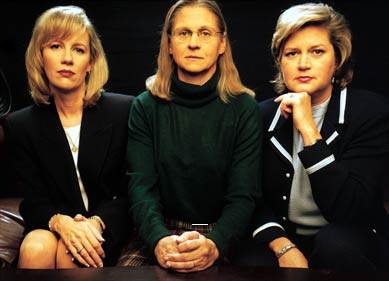
GREGORY HEISLER FOR TIME THE WHISTLE-BLOWERS: Cynthia Cooper, WorldCom; (left to right), Coleen Rowley, the FBI; and Sherron Watkins, Enron
Sally’s World, January 10, 2003
www.worldwit.org
Did you see that TIME Magazine chose three women as their persons of the year? Sharing the honor are Cynthia Cooper of Worldcom, Coleen Rowley of the FBI and Sherron Watkins of Enron.
On its cover TIME dubbed them “The Whisltleblowers.” In the photo, the three women look at the camera straight on, stern-faced, arms crossed, silhouettes dramatically lit, their hair framing their faces like haloes. They look annoyed, a bit like moms who’ve caught their 10-year olds throwing firecrackers at each other in the basement.
The photo portrait of this triumvirate doesn’t exactly fit the formula of what we think of as “out of the box” thinkers, but that is precisely what they are. To think out of the box is to be truly radical. It’s not simply to zig when you see a sign that says “zag,” but to blaze with a light that signals a whole new direction. It’s a risk and it’s a signal of what’s to come.
And in stepping out of the box, what did these three expose? Conflict, pure and simple. The conflict between what their organizations said they were doing and what they were REALLY doing.
I understand why TIME called them whistleblowers, but the term can be seen as, well, negative. It brings to mind other words like snitch and disgruntled. None of these women went to the press. The press went to them when their internal memos were leaked. None of them had an ax to grind. They all loved their jobs and believed in their organizations. As TIME says in its report, they are more like “the truest of the true believers.”
If not whistleblowers, then what to call them? These three “Persons of the Year” wriggled just as uncomfortably with being called heroes or role models.
Here’s a proposal: Let’s call them a harbinger.
And here’s why. Like the first robins of spring, our “Persons of the Year” are a signal of new growth to come in the cultures of our organizations.
If you read the TIME reports about what they did and why they did it, you will see that they were motivated by a desire to help their organizations to succeed and grow.
If this succeed and grow motivation sounds like a “chick” thing to you, well it has for a long time considered to be so. But since these women are a harbinger, it won’t be a “chick” thing for long.
The fact that they stood up could be a sign of an opening in our business organizations of benefit to all of us – men and women and future generations of employees. If we look beyond the headlines and read the subtext, this story is about how people – men and women alike – are driven to connect with each other in mutually enhancing relationships – inside and outside of organization.
It’s an opening that’s been a long time coming and was effectively advanced by Jean Baker Miller in her book, Toward a New Psychology of Women. Penned in 1976 at a time of dramatic change for women, this work is, in my layperson’s opinion, a work of remarkable clarity and brilliance.
Baker-Miller recognized that, socially, women through their activities carry human essentials that are not valued. Of these, the most important woman’s life activity is participating in growth fostering relationships – the process of acting in relationship with another person so that person can develop and grow.
This is the everyday stuff of rising children, and it is often described as nurturing or mothering. But these are gender-based words that negate the fact that all people – men and women alike -want to participate in growth-fostering relationships. Baker-Miller and her colleagues call this mutual psychological development and they say that it is essential to all of life and functioning.
So where do our whistleblowers/harbingers fit into this?
These three were so driven to foster growth within their organizations that they risked the conflict to make the growth happen.
Because women are usually subordinates, they do not actively engage in conflict with their dominants – their bosses. When the conflict is forced underground, it becomes covert, distorted and saturated with “destructive force.” But conflict doesn’t have to be that way, and by it’s nature it is not.
Conflict is actually good for us. Entered into with integrity, respect, confidence and hope, conflict is the source of all growth. “The infant would never grow if it interacted with a mirror image of itself,” Baker-Miller writes. “Growth requires engagement with difference and with people embodying the difference.”
28 years ago in her book, Baker-Miller called on women to reclaim conflict.
That is exactly what the ladies of the harbinger have done.
Their actions show that we have learned at least that much – that some conflict is necessary if we are to grow. Twenty years ago, these three would have had neither the position nor the means to even ponder a conflict. The fact that they stepped forward is a very good sign.
It’s not the end of the road but a beginning. For a long time, many of us have questioned the values of our institutions. We have looked for evolution to a more responsive organization that is more tolerant of authenticity. There’s been a lot of dissatisfaction but few guideposts to the next destination. Many of us have wondered how we have gotten into this mess and how we will get out of it.
“One adopts measures in keeping with his past training–and the very soundness of this training may lead him to adopt the wrong measures. People may be unfitted by being fit in an unfit fitness,” said the noted theorist of rhetoric, Kenneth Burke, who Baker-Miller quotes in her book.
That’s good for a giggle and it’s also true. Our three harbingers have pushed back against the “unfit fitness.”
With a little luck, they have cleared a path and planted a tiny seed for a new type of organization, one that is geared toward engendering authenticity and relationships of mutual growth.
And one that will allow us to have a good, clean fight when we need to.